
GRAIN BOUNDARY DIFFUSION
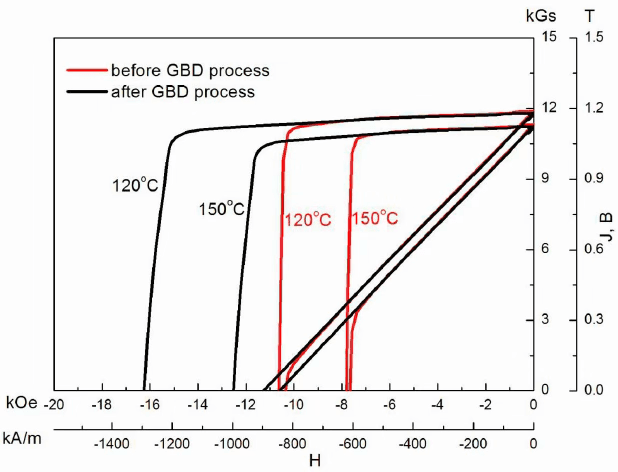
GBD is the most important technology in high-end magnet manufacturing today. It delivers the same thermal stability as traditional methods while using 50-70% less Dysprosium and Terbium.
50-70%
Less Dy/Tb Required
Since 2015
R&D Experience
2023
Radial Rings Capable
Same Hcj
Coercivity Performance
High-temperature magnets require heavy rare earths—Dysprosium (Dy) and Terbium (Tb)—to maintain coercivity at elevated temperatures. Without them, magnets demagnetize when they get hot.
The problem: China controls most of the world's heavy rare earth supply and has implemented export restrictions. Prices are volatile, supply is uncertain, and traditional methods waste material by mixing Dy/Tb throughout the entire magnet when it's only needed at grain boundaries.
Traditional alloying also reduces magnetic strength (Br). You trade thermal stability for weaker magnets.
GBD solves this by applying heavy rare earths only where they're needed—at the grain boundaries.
The result: same thermal stability, full magnetic strength, 50-70% less Dy/Tb. Less material means less exposure to export restrictions and lower cost per magnet.
Since 2023, we've applied GBD to radial multipole rings—the exact geometry needed for humanoid robot joint motors.
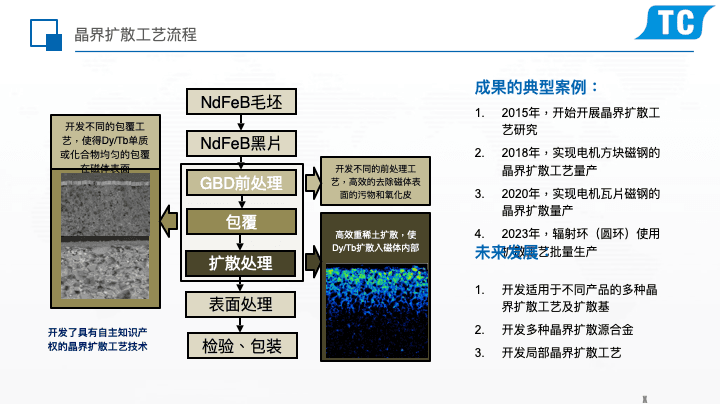
Start with a standard NdFeB magnet blank. Apply a thin layer of Dy or Tb compound to the surface. Heat in vacuum.
During heat treatment, the heavy rare earth atoms migrate inward along grain boundaries—the interfaces between magnetic grains. This is where coercivity is determined.
The atoms concentrate exactly where they're needed, leaving the grain interiors untouched. The result: enhanced coercivity without diluting the Nd₂Fe₁₄B phase that provides magnetic strength.
50-70% less Dy/Tb per magnet means less exposure to China's export restrictions. Your supply chain becomes more resilient.
Dysprosium and Terbium are expensive. Using less of them directly reduces your cost per magnet.
Traditional alloying reduces Br (magnetic strength) to gain Hcj (coercivity). GBD maintains full Br while boosting Hcj.
Our process works on radial rings, arcs, and tiles—not just simple blocks. Critical for robotics and motor applications.
Nearly a decade of continuous development in grain boundary diffusion technology, progressively expanding to more complex magnet geometries.
2015
R&D initiated — began research into GBD technology
2018
Square magnets — mass production of GBD-treated blocks
2020
Tile magnets — extended to arc and tile geometries
2023
Radial rings — mass production of GBD-treated multipole rings for robotics
GBD technology means less dependence on restricted heavy rare earths. Let's discuss your application.